What Happens When You Hire the Community to Fix the Community
STAY IN THE LOOP
Get updates, stories, and ways to take action.
Childhood poverty limits what feels possible. It shrinks the horizon: which careers seem within reach, which futures feel worth planning for, which paths a young person can imagine for themselves. A direct way to change that is to put real jobs and real skills into the hands of young people, right in the neighborhoods where they live. That's exactly what Comic Relief's grantmaking does, and why we're telling you about Philadelphia Urban Green.
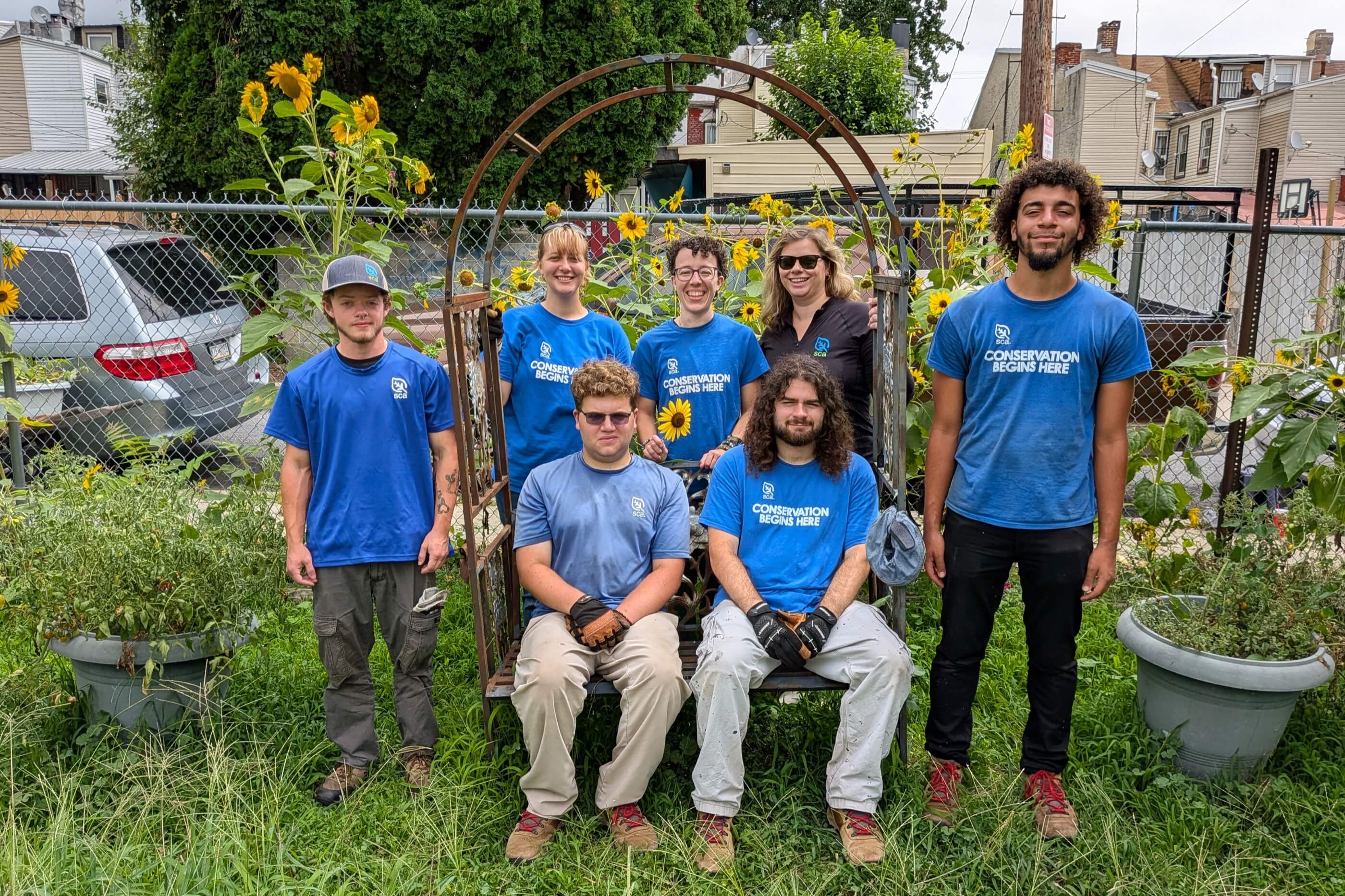
There's nothing like seeing someone from your own community open a door you didn't know existed. That's what Urban Green does, offering paid, hands-on jobs restoring the natural spaces closest to home in Southwest Philadelphia neighborhoods like Elmwood, Eastwick, and Kingsessing, and also in nearby Reading, Pennsylvania. It was launched in 2024 by the Student Conservation Association (SCA), which has supported hands-on conservation programs across the Philadelphia region for more than 20 years.
In a city where nearly half the residents are under 35 (source), and the poverty rate hovers just under 20%, with roughly 300,000 Philadelphians below the poverty line (source), the stakes are high — and the need for locally rooted, career-building programs has never been greater. Urban Green meets that need head-on: local teenagers earn income restoring trails and waterways, and young adults train directly into conservation careers.
For Alexandra Ratliff, this work is personal. She grew up outside Pittsburgh, where a nearby river gave off a sulfuric smell she didn't understand as pollution until years later. "There's not a section in a school that teaches you this," she said.
Like many of her colleagues, Alexandra participated in SCA's programs herself, starting as an intern before working her way into a full-time role at the organization where she is now an executive. She loves seeing Philly's young people find that same sense of purpose that led to her own fulfilling career.
How It Works
High schoolers aged 15–19 join Urban Green as paid crew members, meeting at the John Heinz National Wildlife Refuge in Southwest Philadelphia on Saturdays during the school year and expanding to weekday programming each summer. Program manager Darien Manning has lived in Philly for years, and knows firsthand what its neighborhoods need.
The work is hands-on: restoring waterways, planting trees, clearing invasive species, and maintaining trails. On some days, that means paddling out in kayaks along the refuge's waterways, hauling in pounds of trash that's drifted too far from shore for anyone on land to reach, then heading back out to do it again. On others, participants harvest vegetables at a community garden, separating hundreds of pounds of produce bound for a local food bank.
The program extension in Reading allows young adults 18 and older to take things a step further, pairing conservation work in that city with weekly career development sessions that lead directly to certifications and job placement. It's similar to the Philly teen program, just aimed at an older group who are closer to entering the workforce.
Two years in, the results are visible. Since the relaunch, 133 young people have come through Philadelphia Urban Green, and 90% say they've gained confidence, 76% say they're more interested in a conservation career, and 74% now see themselves as conservation leaders. Crews have restored over 20,000 feet of shoreline and waterway, maintained more than 12,000 feet of trail, and improved 2,200 acres of land.
Here’s One Example
Marissa Mora first came to SCA through its national internship program, working at John Heinz National Wildlife Refuge in 2022. They returned to Philadelphia in June 2025, this time as an Urban Green Crew Leader, leading 21 high-school-aged crew members through projects including tree planting, urban gardening, and invasive species management, alongside the professional development built into every Urban Green session. Along the way, Marissa discovered they loved the teaching part most of all.
Their work didn't go unnoticed. Marissa's supervisor recommended them to the hiring team at Bartram's Garden, a Philadelphia nonprofit and Urban Green partner. This July, Marissa was hired as the Garden Ecology Youth Program Educator, doing the same kind of work but as a permanent staff member.
Marissa says that "outdoor education instills within me a deep sense of joy to learn from the land alongside fellow plant people. My time as a Crew Leader has been exciting, challenging, inspiring, and has truly supported my continued development as an educator."
Local by Design
Marissa's path isn't an exception. It's what happens when projects are chosen based on what local partners identify as the priority, crews of Philly's own teenagers do the work, and a growing roster of employers, like Bartram's Garden, are ready to hire Urban Green's graduates.
For Alexandra, the case isn't just in the numbers. It's in what she's watched happen for Philadelphia kids like her, growing up without the language to describe the injustice in their own backyard, and who are now the ones changing it. "Young people are the solution," she said, "and we must invest in that to invest in our future."
That's Comic Relief's belief, too: back the people closest to the problem, and help proven models like Urban Green grow beyond one city, one crew, one career at a time.
Related


One School's Answer to "This Problem Feels Too Big"
When communities lead, kids thrive. Here’s how we’re using comedy to make that happen.